 ASOC
ASOC
World Park AntarcticaArchived
The World Park campaign was the first Antarctic environmental movement.
Formed in response to the threat of mining in Antarctica, the decade-long efforts of ASOC members, partners, and the public concluded with a historic commitment to protect Antarctica for all of humanity.
The Madrid Protocol, adopted in 1991, designates Antarctica ‘a natural reserve, devoted to peace and science’, and bans mining and oil drilling indefinitely.


Background
WORLD PARK ANTARCTICA
In the 1970s pressure was growing from governments and businesses to start mining in Antarctica. Antarctic Treaty nations began to draft a regulatory framework to manage the emerging industry. Negotiations took place at secretive meetings attended by just 13 nations.
While these negotiations were underway, James Barnes, an environmental lawyer with the Centre for Law and Social Policy (CLASP), received a tip-off that Antarctic Treaty parties were developing a plan to permit mineral and gas prospecting in Antarctica.
He managed to obtain a secret copy of one of the early drafts of the framework, which he distributed publicly. Many were outraged at the prospect of mining the last great wilderness on earth, and together they coordinated the first international campaign to protect Antarctica.
A global effort
WORLD PARK ANTARCTICA
As word spread amongst environmental organizations, it became clear it would take a global effort to protect the world’s last great wilderness.
In 1978 Barnes founded ASOC to provide a unified voice for non-governmental organizations working to protect Antarctica.
This was the beginning of the World Park campaign, which would bring together Antarctic campaigners from all around the world, and last over a decade.
“[It is] fundamentally crazy to be thinking about obtaining oil and other minerals that may be in the Antarctic, particularly in view of the latest reports from the scientific community in the climate context.”
ASOC Founder, Jim Barnes


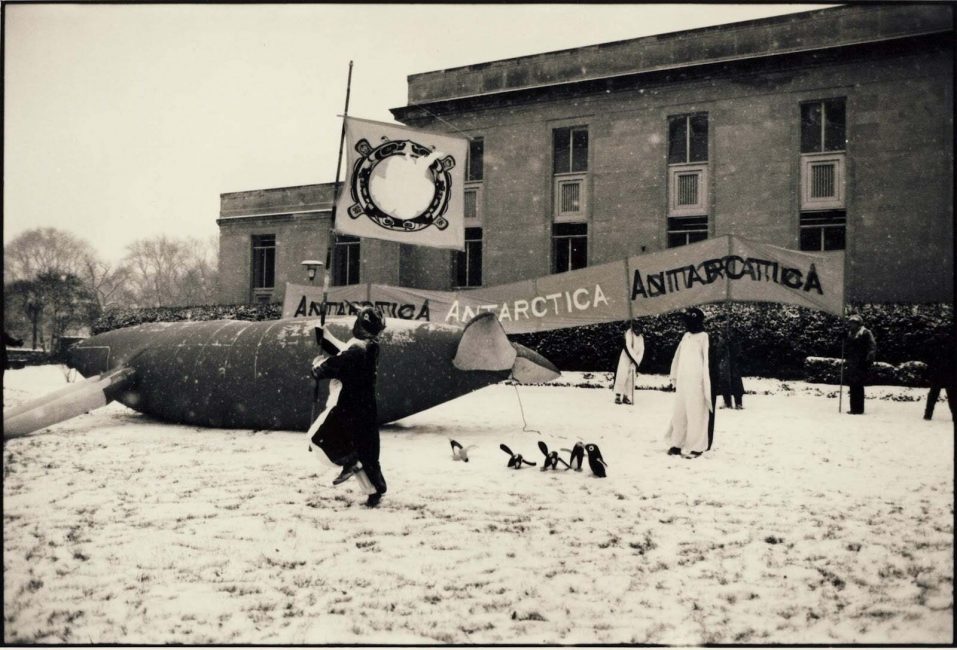
Political penguins & Antarctic occupation
WORLD PARK ANTARCTICA
With the support of environmental activists, scientists, and lawyers, the World Park campaign gained traction. Campaigners held public protests, lobbied states and international organizations, and recruited celebrities to the cause.
Greenpeace campaigners built a remote field camp on Ross Island in East Antarctica, where they monitored nearby research stations, exposing their polluting waste disposal practices.
A petition to protect Antarctica from mining organized by ASOC and the Cousteau Society gained 1.5 million signatures in less than a year.
Read about the Greenpeace World Park Antarctica campaign.
Read about the Greenpeace (New Zealand) 1970-80 campaign to protect Antarctica.

Against all odds
WORLD PARK ANTARCTICA
Despite overwhelming global resistance, Antarctic Treaty parties adopted the Convention on the Regulation of Antarctic Mineral Resource Activities (CRAMRA) in 1988. The Convention laid out a framework for regulating mining in Antarctica.
But campaigners refused to admit defeat. Instead they doubled down on their efforts, continuing to build public awareness of the threat mining posed to Antarctica and its wildlife.
Less than a year later Australia and France withdrew their support for CRAMRA, effectively forcing its abandonment, as the Antarctic Treaty System requires the consensus of all Consultative Parties to adopt a new Convention.

A new proposal
WORLD PARK ANTARCTICA
The following year Australia and France, joined by New Zealand, India, and Belgium, proposed an alternative to CRAMRA. Instead of regulating mining, they suggested a new convention to provide comprehensive protection for the Antarctic, create conditions conducive to ongoing scientific research, and ban mining and oil drilling indefinitely.
This represented a radical departure from the principles underlying CRAMRA, an agreement reached after almost a decade of delicate negotiations. Despite this, the new proposal was supported by all Consultative Parties, and negotiated in just under a year.

Antarctic Treaty Nations Adopt Environmental Protocol
WORLD PARK ANTARCTICA
On 4th October, 1991, Antarctic Treaty Parties adopted the Protocol on Environmental Protection to the Antarctic Treaty.
The Protocol commits signatories to “the comprehensive protection of the Antarctic environment” and designates the entire continent “as a natural reserve, devoted to peace and science.” It also bans any “activities relating to Antarctic mineral resources, except for scientific research.”
The Parties commit themselves to the comprehensive protection of the Antarctic environment and dependent and associated ecosystems and hereby designate Antarctica as a natural reserve, devoted to peace and science.
Article II, Protocol on Environmental Protection to the Antarctic Treaty.

Into the future
WORLD PARK ANTARCTICA
After decades of campaigning, ASOC celebrated the introduction of the Protocol on the Environmental Protection to the Antarctic Treaty. However, there is still work to be done.
In 1991 ASOC was granted official observer status within the Antarctic Treaty System. This designation recognises the vital contribution made by environmental NGOs in Antarctic governance.
ASOC delegates represent the environmental community at annual meetings, attending as invited experts. By equipping decision makers with the best available science, ASOC advocates for informed, environmentally responsible decisions that put Antarctic protection first.
ENVIRONMENTAL PROTOCOL
What ASOC is doing
We work within the system to advocate for the full implementation of the Environmental Protocol, and the highest level of protection for Antarctic ecosystems. Areas of focus include:

Full Implementation
ASOC supports the full and effective implementation of the Protocol on Environmental Protection to the Antarctic Treaty.

Environmental Liability
ASOC advocates for strengthening liability and accountability for states and operators who cause damage to the Antarctic environment, threatening its land, waters, and species.
PROTECTING ANTARCTICA
Thank you
ASOC has represented the global environmental community for over 40 years. We couldn’t do it without the support of our members, partners and a global network of Antarctic advocates.
Join us today as we continue to work towards the strongest possible protection for Antarctica and its wildlife.
Antarctic affairs
PROTOCOL ON ENVIRONMENTAL PROTECTION TO THE ANTARCTIC TREATY
Now that you’ve learned about the success of the World Park campaign, read on to learn about the important issues facing Antarctica today.
