 ASOC
ASOC

Overview
Gentoo PENGUINS
Scientific name: Pygoscelis papua.
Average height: 29–35 inches (75–90 centimeters).
Average weight: 10–18 pounds (4.5–8.5 kilograms).
Average lifespan in the wild: 15–20 years.
IUCN Red List status: Least concern, population stable (2019).

Range
Gentoo PENGUINS
Gentoo penguins have a wide, circumpolar distribution, and can be found as far south as 65°S. Breeding colonies are found on the Antarctic Peninsula, South Shetland, South Orkney and South Sandwich Islands, as well as subantarctic islands across the Southern Ocean. They travel widely to forage, and vagrants have been seen on the coastlines of Argentina, New Zealand and Tasmania.

Identification
Gentoo PENGUINS
Gentoo penguins are the third-largest member of the penguin family, after emperor and king penguins. They are a member of the brush-tailed penguin family, and are closely related to Adélie and chinstrap penguins.
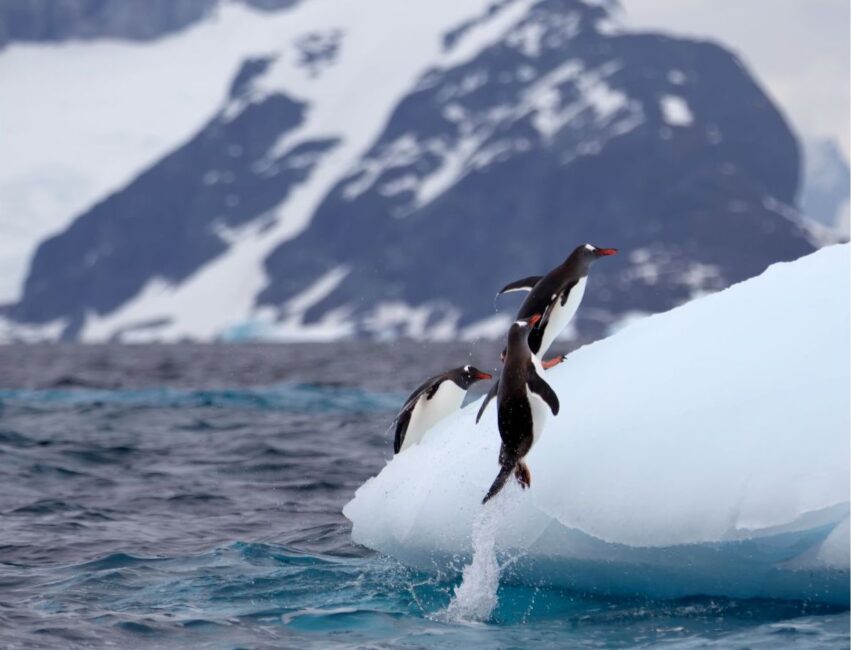
Gentoo penguins can be identified by their bright orange beaks, peach-coloured feet, and a distinctive band of white feathers over the top of their otherwise black head.
Like most seabirds, they have black backs and white chests, which makes it more difficult for marine predators to see them in the water.

Feeding
GENTOO PENGUINS
Gentoo penguins are considered ‘generalist’ feeders, with a diverse diet of fish, squid, and krill.
Research suggests that while foraging, they take a series of short ‘exploratory dives’ to around 13 feet (4 meters) depth, before taking deeper dives up to 260 feet (80 meters) to feed. They may take up to 450 dives per day.
They can, however, dive much deeper. The deepest recorded gentoo penguin dive was 688 feet (210 meters) deep.
Gentoo penguins are also the fastest diving birds on Earth, swimming at speeds of up to 22 miles per hour (36 kilometers per hour).


Life cycle
Gentoo PENGUINS
Gentoo penguins generally form colonies on low-lying, rocky beaches across subantarctic islands and northern Antarctica. Each spring they congregate in groups of a few to a few thousand, building their nests out of small stones in preparation for the breeding season.
Gentoo penguins can breed from two years of age, but most wait until they are four. Females lay two eggs between June and December, depending on how far south they are.
Eggs incubate for 34 to 37 days and hatchlings are born in early summer, with parents taking turns providing food, shelter, and warmth for the rapidly growing chicks.

Life cycle
Gentoo PENGUINS
After four to five weeks chicks venture away from the nest, forming groups with other chicks. These groups, called creches, allow chicks to gain some independence while enjoying safety in numbers.
Chicks fledge after 62-117 days, with the fledging period being up to twice as long in the northern latitudes than the southern. Their downy feathers are replaced by waterproof adult plumage, and they begin to learn to swim. Parents stop feeding them around this time, returning to sea to feed up before their annual molt. They will spend 2-3 weeks on land, fasting while their old feathers are replaced with new ones.
Gentoo penguins don’t migrate. Many forage close to their colonies through the winter, while some forage further afield. Some gentoo penguins breeding on the Antarctic Peninsula may travel north in the winter to forage along the sea ice edge.

Predators
gentoo PENGUINS
Orca (killer whales) and leopard seals both prey on gentoo penguins at sea. The penguins have distinctive black and white plumage, which provides a form of camouflage against the sea or sky called countershading. This offers some protection from marine predators. They also porpoise while swimming, breaking through the surface of the water much like dolphins. This motion may be used to build up speed or confuse predators.
On land, eggs and chicks are vulnerable to predation from southern giant petrels, skuas, and snowy sheathbills.
Adult penguins defend their chicks ferociously from aerial attacks, vocalizing and slapping predators with their rigid flippers to deter them.
ASOC recommends:
Although gentoo penguin populations are strong, they depend on many ocean resources that may be at risk because of overfishing. The establishment of protections now could make a difference in the long-term survival of gentoo penguins.
Protecting gentoo penguins
gentoo PENGUINS
GENTOO PENGUINS
Related reading




References:
Bost et al. (1994). Maximum diving depth and diving patterns of the Gentoo Penguin Pygoscelis Papua at the Crozet Islands.
Chen et al. (2021). Existence and features of the myodural bridge in Gentoo penguins: A morphological study.
Lee et al. (2021). Inter-Specific and Intra-Specific Competition of Two Sympatrically Breeding Seabirds, Chinstrap and Gentoo Penguins, at Two Neighboring Colonies.
Polito et al. (2015). Contrasting specialist and generalist patterns facilitate foraging niche partitioning in sympatric populations of Pygoscelis penguins.
Shirihai (2003). The Complete Guide to Antarctic Wildlife: Birds and Marine Mammals of the Antarctic Continent and the Southern Ocean.
Scientific consultation: Heather Lynch, Professor of Ecology and Evolution, School of Marine and Atmospheric Sciences, Stony Brook University, 2024.
Now that you’ve learned about gentoo penguins, read on to discover more about extraordinary Antarctica.
Antarctic Penguins
FEATURED LEARNING
