ASOC
ASOC

Fast facts
KING PENGUINS
Scientific name: Aptenodytes patagonicus.
Average height: 33-37 inches (85–95 centimeters).
Average weight: 21–40 pounds (9.3–18 kilograms).
Average lifespan in the wild: 26 years.
IUCN Red List status: Least concern, population increasing (2020).

Range
KING PENGUINS
King penguin colonies are found across the subantarctic and Southern Ocean north of 60°S, with large populations on Iles Crozet, Iles Kerguelen and South Georgia. Some colonies have hundreds of thousands of breeding pairs each summer.
Historically, king penguins have seldom visited Antarctica itself, preferring the relatively temperate conditions around the Antarctic convergence for both breeding and feeding. However they are starting to move southwards, with individuals seen on Elephant Island, South Shetland Islands. According to some researchers, this is almost certainly a direct result of climate change.

Identification (juvenile)
KING PENGUINS
King penguins go through many evolutions in their appearance from hatchlings to mature adults.
Newly hatched king penguin chicks weigh less than a pound (500 grams) and have little or no down. Over several months they develop a light covering of brown down, which gradually becomes longer and slightly paler. After around 40 days king penguin chicks are fully covered in a mass of fluffy, brown down.
Chicks remain brown until their first molt, when they get their adult plumage. Initially the colors are less vivid than fully fledged adults, and they deepen and brighten over several years. They receive their full adult plumage at around 3 years of age.

Identification (mature)
KING PENGUINS
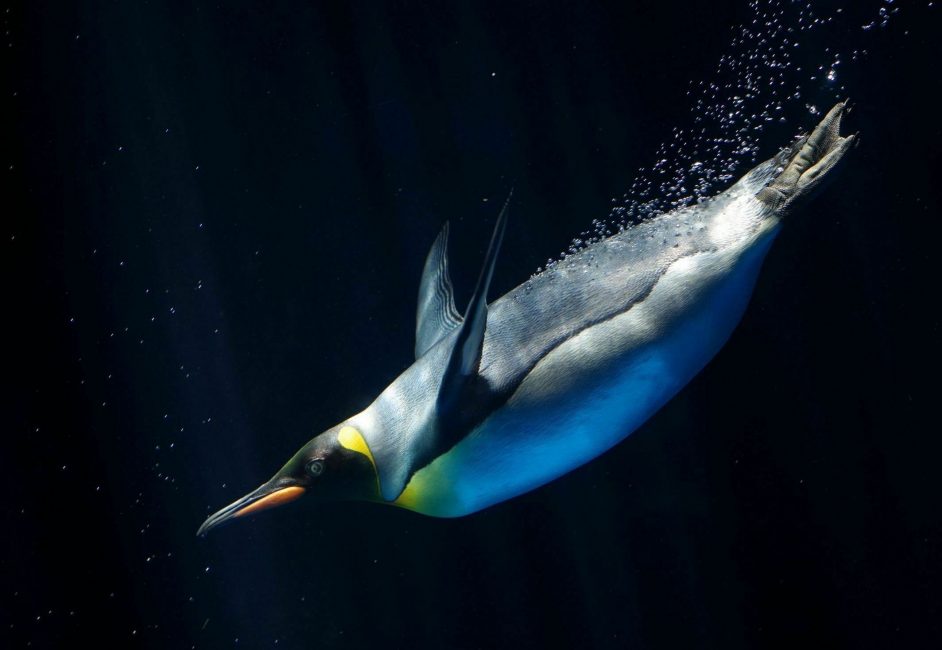
Adult king penguins have a dark head with orange to yellowish teardrop-shaped spots on both sides. A splash of intense orange plumage near the throat fades to pale yellow on the upper chest, and white on the belly. They have a black back, which may have a silvery-blue sheen.
The second largest of the penguins, king penguins are easily confused with emperor penguins due to their size and vivid markings, and the fact that they incubate their eggs under a brood pouch on their feet. However, king penguins tend to have more colorful plumage than emperors, and a longer, more slender bill.

Feeding
KING PENGUINS
King penguins forage at sea up to 620 miles (1000 kilometers) from their colonies. Their diet varies depending on their location and the time of year, but generally includes squid and fish, particularly lanternfish. Like most seabirds, king penguins store food and regurgitate it later to feed their chicks.
King penguins are master divers, diving to depths of over 1,180 feet (360 meters) in pursuit of food. They can spend up to 10 minutes underwater, but typically resurface after 5 minutes.

Predators
KING PENGUINS
Skuas, giant petrels, kelp gulls, and snowy sheathbills frequent king penguin colonies, feeding on unguarded chicks and eggs. Adult penguins defend their chicks ferociously from aerial attacks, vocalizing and slapping predators with their rigid flippers to deter them.
At sea, king penguins are a food source for leopard seals, fur seals, and killer whales. They have distinctive black and white plumage, which provides a form of camouflage against the sea or sky called countershading. This offers some protection from marine predators. They also porpoise while swimming, breaking through the surface of the water much like dolphins. This motion may be used to build up speed or confuse predators.
In the past, king penguins were also heavily hunted by humans for their meat, oil, blubber, and feathers. Today they are fully protected.

Life cycle
KING PENGUINS
The king penguin breeding cycle is quite unusual, both among penguins and the bird kingdom more broadly. Breeding pairs typically breed twice every three years, with a full breeding cycle taking 13-16 months. Breeding can take place at any time except during molt. Due to this irregular breeding cycle, at any time of year some birds are foraging, some are nesting, and some are in colonies mating, molting or roosting. Most nesting areas will host a mix of chicks, immature and adult birds at various stages of development.
King penguins reach sexual maturity at around 3 years old, however most don’t begin to breed until they are between 5 and 6 years old. They are known as ‘serial monogamists’, taking one partner each breeding season and working together to raise their chick, before choosing a new partner the following year.

Molting and breeding
KING PENGUINS
Before mating, king penguins undergo an annual molt. Over a period of around 30 days they lose all their weathered feathers and grow a new coat of waterproof plumage.
Males court females with trumpeting calls and visual displays, bowing, stretching to their full height and raising their bills skyward. Males and females may also groom one another in preparation for mating. Courtship can last up to one month.
After mating, the female lays one egg, and both parents take turns foraging and incubating the eggs under a brood pouch on their feet, like emperor penguins. The egg hatches after 50 to 60 days, and the parents continue to take turns minding their chick and foraging for food to sustain them.

Forming crèches
KING PENGUINS
Around 40 days after hatching, chicks are large enough to survive on their own. Covered in fluffy brown down, they band together to form groups called crèches. Chicks rely on each other for warmth and protection from predators while they grow and learn how to survive on their own.
Most chicks go through three stages of development: an initial growth spurt during which time they grow almost to full size, although they are still covered in brown down; a period of fasting and weight loss during winter; and a final growth spurt and molt before fledging. King penguins become fully independent around 16 months after birth.
ASOC recommends:
Although king penguin populations are strong, they depend on marine ecosystems that may be at risk because of climate change and overfishing. As the ocean warms and fishing increases, establishing strong protections now could make a difference in the long-term survival of king penguins.
Protecting king penguins
KING PENGUINS

KING PENGUINS
Related reading


References:
Shirihai (2003). The Complete Guide to Antarctic Wildlife: Birds and Marine Mammals of the Antarctic Continent and the Southern Ocean.
Scientific consultation: Heather Lynch, Professor of Ecology and Evolution, School of Marine and Atmospheric Sciences, Stony Brook University, 2024.
Now that you’ve learned about king penguins, read on to discover more about extraordinary Antarctica.
Antarctic Penguins
FEATURED LEARNING