 ASOC
ASOC

Overview
MACARONI PENGUINS
Scientific name: Eudyptes chrysolophus.
Average height: 27 inches (71 centimeters).
Average weight: 6.8 to 14.5 pounds (3.1 to 6.6 kilograms).
Average lifespan in the wild: 10–20 years.
IUCN Red List status: Vulnerable, population decreasing (2020).

Range
MACARONI PENGUINS
There are more than 250 macaroni penguin colonies across the Southern Ocean, most of them on subantarctic islands, although they also occasionally nest on the outer Antarctic Peninsula. Feeding journeys can take them as far north as southern Brazil and South Africa.
With an estimated breeding population of 18 to 24 million, they may be the most abundant penguin in the world. However, their numbers have been declining since the mid-1970s and their conservation status is ‘vulnerable’.
Identification
MACARONI PENGUINS
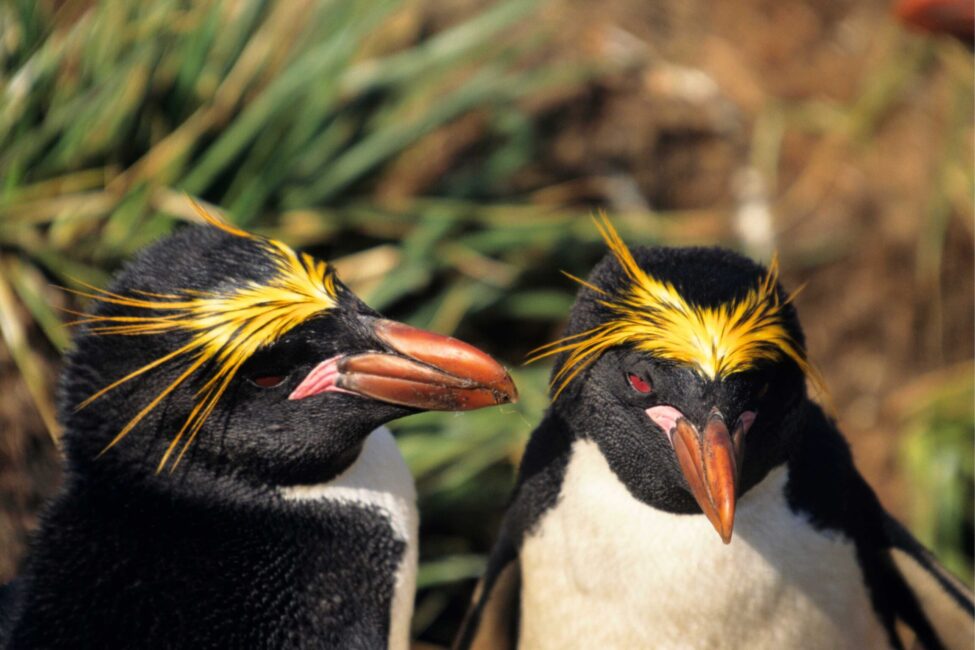
Macaroni penguins are a member of the crested penguin family. Macaroni penguins have large red-to-pink bills, and tend to hop or bounce on land, rather than waddle.
They were named by British sailors who admired their elegant, long crests. These orange-yellow plumes reminded sailors of the ‘macaroni’ fashion in eighteenth century Britain, which included hats with large feathers. The line “stuck a feather in his cap and called it macaroni” from the song Yankee Doodle refers to the same fancy style.
The macaroni penguin range overlaps with the slightly smaller rockhopper penguin. They look similar, but the rockhopper has shorter head plumes, and red eyes.

Feeding
MACARONI PENGUINS
Macaroni penguins feed mainly on krill, and are thought to be the largest consumer of marine resources of all seabirds, eating tons of krill per year. They also eat other crustaceans, small fish, and small amounts of squid.
Macaroni penguins can travel over 185 miles (300 kilometers) to find a hunting site, diving an average of 65 to 100 feet (20-35 meters) in search of food, although they can dive as deep as 375 feet (115 meters). They usually forage during the day, diving for around 2 minutes at a time. When they do feed at night, their dives are generally much shallower.

Life cycle
MACARONI PENGUINS
Macaroni penguins tend to live in rocky areas on beaches and cliffs above the ocean, and have some of the largest, densest breeding colonies of all penguin species.
They return to their colonies in the summer months, which start around October depending on the latitude. Female macaroni penguins mature sexually at five years old, males at six, and they are serially monogamous, generally returning to their previous mating partners.
The female macaroni penguin lays two dimorphic eggs (eggs of different sizes) in a shallow dip in the ground around November, incubating only the larger one. Both parents remain at the nest to keep the egg warm for the first 12 days. Then they alternate in 12 day cycles, taking turns incubating the egg and feeding at sea until the egg hatches at 33-37 days.

Life cycle
MACARONI PENGUINS
For the first three to four weeks the male looks after the chick while the female brings food for them both. When the chicks are large enough they gather with other chicks in groups called creches. Creches provide the young penguins with both independence and safety in numbers, and frees up both parents to hunt, bringing food back for their rapidly growing chick.
After 60 to 70 days the chick gains its full adult plumage and is ready to go to sea.

Predators
MACARONI PENGUINS
Adult macaroni penguins are preyed upon by fur seals, leopard seals, and killer whales at sea. The penguins have distinctive black and white plumage, which provides a form of camouflage against the sea or sky called countershading. This offers some protection from marine predators. They also porpoise while swimming, breaking through the surface of the water much like dolphins. This motion may be used to build up speed or confuse predators.
On land their eggs, chicks and dead adults may become food for predatory birds, including skuas, giant petrels, snowy sheathbills, and gulls. Penguins defend themselves vigorously from these aerial attacks, vocalizing and slapping predators with their rigid flippers to deter them.
ASOC recommends:
Macaroni penguins are classified as ‘vulnerable’ by the International Union for Conservation of Nature, and their population has declined rapidly in recent decades. It is not exactly clear what has caused this change but overfishing, a warming climate, and introduced predators may play a role. The establishment of protections now could make a difference in the long-term survival of macaroni penguins.
Protecting macaroni penguins
MACARONI PENGUINS

MACARONI PENGUINS
Related reading


References:
Brown. (1986). Traveling speed and foraging range of macaroni and rockhopper penguins at Marion Island
Croxall et al. (1993). Diving pattern and performance in the macaroni penguin Eudptes chrysolophus.
Shirihai (2003). The Complete Guide to Antarctic Wildlife: Birds and Marine Mammals of the Antarctic Continent and the Southern Ocean.
Scientific consultation: Heather Lynch, Professor of Ecology and Evolution, School of Marine and Atmospheric Sciences, Stony Brook University, 2024.
Now that you’ve learned about macaroni penguins, read on to discover more about extraordinary Antarctica.
Antarctic Penguins
FEATURED LEARNING
