 ASOC
ASOC

Southern rockhopper penguin
Southern ROCKHOPPER PENGUINS
Scientific name: Eudyptes chrysocome.
Average height: 18 to 21.5 inches (45 to 55 centimeters).
Average weight: 4.5 to 8 pounds (2.0 to 3.8 kilograms).
Average lifespan in the wild: 10 years.
IUCN Red List status: Vulnerable, population decreasing (2020).
Range
Southern ROCKHOPPER PENGUINS
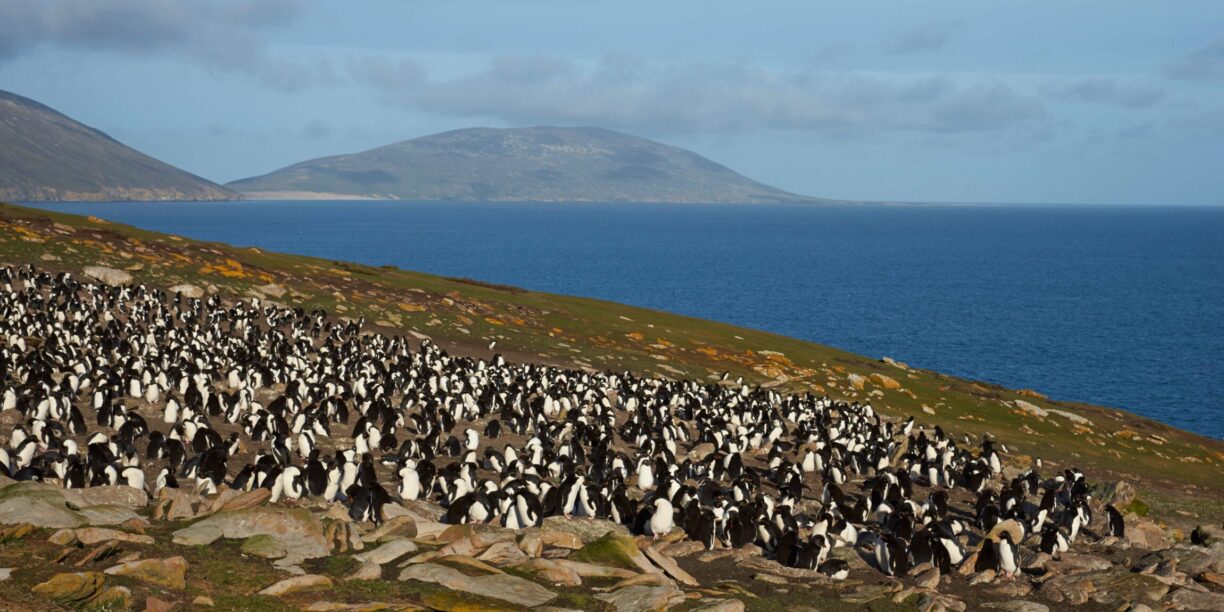
Southern rockhopper penguins have a circumpolar distribution, and generally prefer rocky territory for their colonies and nests. Their breeding colonies are found across subantarctic islands in the region of 46° to 54° South, including South Georgia, the Falkland Islands, Heard Island and Macquarie Island. The closely related northern rockhopper penguin is found slightly further north, on islands in the South Atlantic and Indian Oceans.
Over the past few decades, the population of southern rockhopper penguins has significantly decreased. Today they are classified as a ‘vulnerable’ species by the International Union for Conservation of Nature.

Identification
Southern ROCKHOPPER PENGUINS
The southern rockhopper penguin is the smallest penguin in the genus Eudyptes. It has a slate-gray back and head, red eyes, a pink beak and bright yellow crests. You can distinguish southern rockhoppers from other crested penguins by their smaller size, and thinner, paler crest feathers.
Their common name refers to the fact that, unlike many other penguins which waddle, slide, and totter using their wings as aid, rockhopper penguins jump confidently across cracks, over boulders and up steep slopes.

Feeding
Southern ROCKHOPPER PENGUINS
Southern rockhopper penguins have a flexible diet, which varies depending on their location, prey availability, sea ice cover and other seasonal variables. They also employ different hunting strategies depending on conditions.
They generally leave their colonies in groups in the morning, staying at sea for up to 12 hours at a time. They travel up to 100 miles (160 kilometers) from their colonies in search of food, diving 30 to 82 feet (10 to 25 meters) on average. They are capable of diving much deeper however, and one study has recorded a dive depth of 330 feet (100 meters). Night dives are typically shallower than day dives, and penguins in subantarctic waters dive deeper and for longer than those in warmer waters, where food is more easily accessible.

Life cycle
Southern ROCKHOPPER PENGUINS
The breeding season typically ranges from October to March, with the exact timing varying by up to 6 weeks depending on the location of the colony and the prevailing conditions each year.
Males return to the colony before females to rebuild their nest. When the females arrive they generally return to the same partner and nest as the previous year to mate.
Females usually lay 2 dimorphic eggs (eggs of different sizes) from mid-November. Both partners remain at the nest for several days before the male goes to sea to feed for 2 to 4 weeks. The female incubates both eggs, which hatch after 32 to 38 days.

Forming creches
Southern ROCKHOPPER PENGUINS
When the male returns he guards the hatchlings for about 25 days while the female forages and feeds the chicks. By this time the chicks are becoming strong enough to fend for themselves, and leave the nest to join groups of chicks called creches.
Chicks are fully fledged at around 66 to 73 days, with waterproof adult plumage and the ability to forage for themselves. Before returning to sea for the winter, adult penguins undergo an annual molt, replacing their worn feathers with new waterproof plumage.


Predators
Southern ROCKHOPPER PENGUINS
Adult southern rockhopper penguins are preyed upon by fur seals, sea lions, leopard seals, and killer whales at sea. The penguins have distinctive black and white plumage, which provides a form of camouflage against the sea or sky called countershading. This offers some protection from marine predators. They also porpoise while swimming, breaking through the surface of the water much like dolphins. This motion may be used to build up speed or confuse predators.
On land their eggs, chicks and dead adults may become food for predatory birds, including skuas, giant petrels, snowy sheathbills, and gulls. Penguins defend themselves vigorously from these aerial attacks, vocalizing and slapping predators with their rigid flippers to deter them.
ASOC recommends:
Southern rockhopper penguins are considered vulnerable, and their population is estimated to have decreased by 30 percent over the past 30 years. It is not exactly clear what has caused this change but overfishing, a warming climate and oil pollution may play a role. The establishment of protections now could make a difference in the long-term survival of southern rockhopper penguins.
Protecting southern rockhopper penguins
Southern ROCKHOPPER PENGUINS

Southern Rockhopper PENGUINS
Related reading


References:
Brown. (1986). Traveling speed and foraging range of macaroni and rockhopper penguins at Marion Island
Pütz. (2006). Diving characteristics of southern rockhopper penguins ( Eudyptes c. chrysocome) in the southwest Atlantic.
Shirihai (2003). The Complete Guide to Antarctic Wildlife: Birds and Marine Mammals of the Antarctic Continent and the Southern Ocean.
Tremblay & Cherel. (2003). Geographic variation in the foraging behaviour, diet and chick growth of rockhopper penguins.
Wilson et al. (1997). Southern rockhopper penguin Eudyptes chrysocome chrysocome foraging at Possession Island.
Scientific consultation: Heather Lynch, Professor of Ecology and Evolution, School of Marine and Atmospheric Sciences, Stony Brook University, 2024.
Now that you’ve learned about southern rockhopper penguins, read on to discover more about extraordinary Antarctica.
Antarctic Penguins
FEATURED LEARNING
