 ASOC
ASOC
Fast facts
ROSS SEAL
Scientific name: Ommatophoca rossii.
Average Length: Up to 7.6 feet (2.3 meters), females slightly larger than males.
Average Weight: 330-470 pounds (150-215 kilograms).
Diet: Lanternfish (myctophid), Antarctic silverfish, and squid.
Average lifespan in the wild: 15-20 years.
IUCN Red List status: Least concern (2014).

Range
ROSS SEAL
Ross seals are the smallest and rarest species of Antarctic true seal, thought to make up only 1% of all seals living in the Antarctic pack ice.
Breeding and molting in areas of medium to dense pack ice south of 60°S latitude, Ross seals are quiet elusive and difficult for humans to access. They have however been observed or biologged* in the East Antarctic, the Lazarev Sea (Queen Maud Land), and the Amundsen Sea.
*Biologging refers to researchers attaching small electronic devices or tags to animals to monitor their movements and behaviors.

Identification
ROSS SEAL
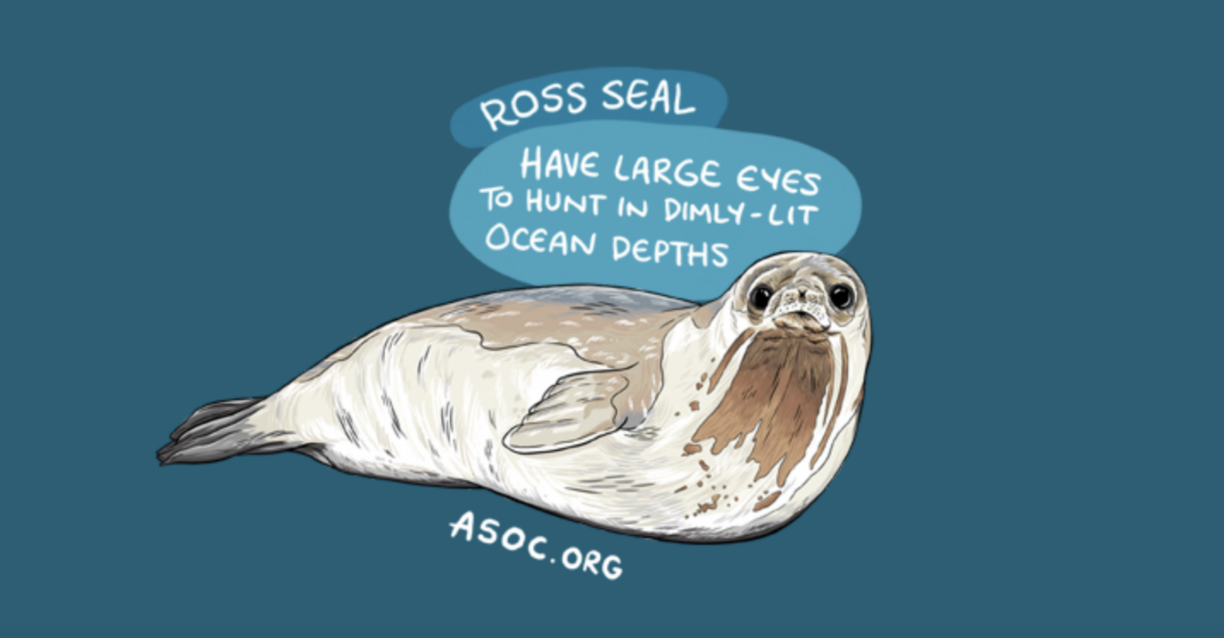
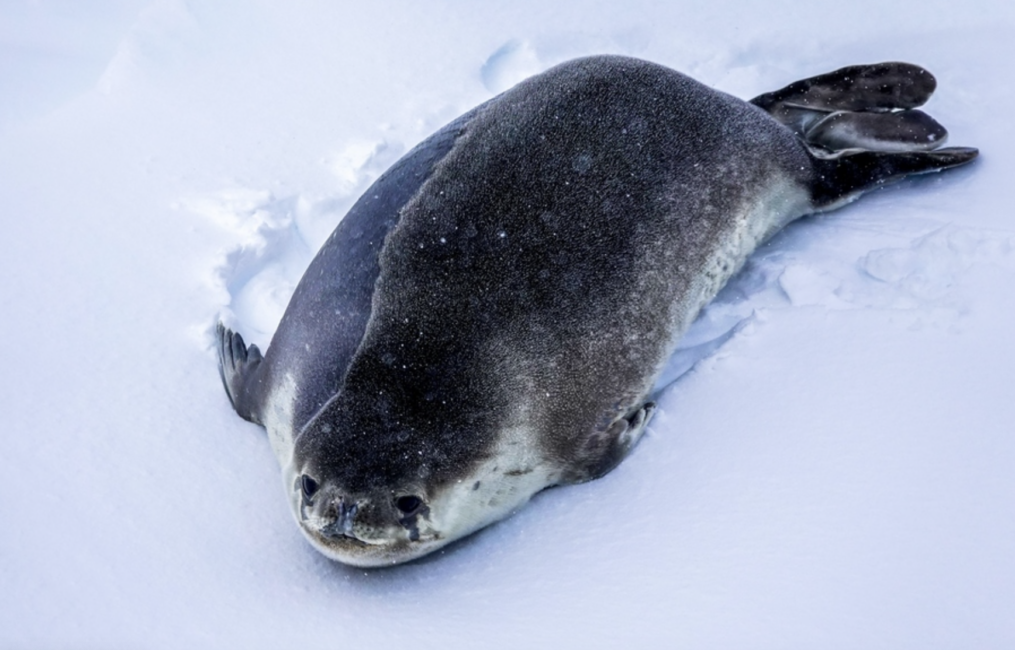
Ross seals have a slender body, thick neck, short face, and the shortest hair and vibrissae (whiskers) of any true (earless) seal. Their coat tends to be dark brown with a silvery belly. They often have spots or broad, dark stripes extending along their necks and sides from chin to chest.
Ross seals have extremely large eyes up to 2.75 inches (7 centimeters) in diameter, with large pupils, which may help them navigate or find prey in dark waters.
Ross seals are generally solitary, and have been reported to emit a call that sounds like a siren when approached by humans. They may also raise their head, open their mouths and arch their backs almost ninety degrees, a behavior unique amongst Antarctic true seals.

Feeding
ROSS SEAL
Ross seals feed primarily on Lanternfish (myctophid), Antarctic silverfish, and squid, although their diet can include crustaceans such as Antarctic krill, and benthic invertebrates.
While Ross seals are considered ice-dependent, they are thought to spend much of their time foraging in open water, away from the strong currents that can develop at the ice edge. They can dive to almost 1000 feet deep and stay underwater for more than 20 minutes at a time, although most of their dives are shorter and shallower. They can also travel some distance from the ice in search of food – studies tagging Ross seals have tracked them as far north as the Falkland Islands and South Australia.

Predators
ROSS SEAL
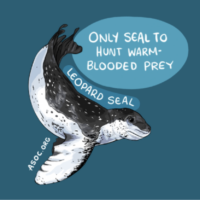
Little is known about predators of Ross seals, but they most likely include orca (killer whales) and leopard seals.
Some sightings of adult Ross seals have noted small scars around their neck and shoulders, a possible indication of close encounters with sharp-toothed predators.
Life cycle
ROSS SEAL
Females are believed to reach sexual maturity between 2 and 4 years of age, males from the age of 3. Pups are generally born in October or November after a gestation period of around 9 months. In the 1990s scientists believed that females nurse their pups for 4 – 6 weeks. However more recent observations suggest nursing could be as short as 13 days. Adult Ross seals haul out on consolidated pack ice to molt between December and February.
ANTARCTIC SEALS
Related reading
References:
Shirihai (2003). The Complete Guide to Antarctic Wildlife: Birds and Marine Mammals of the Antarctic Continent and the Southern Ocean.
Arcalis-Planas et al. (2014). Limited use of sea ice by the Ross seal (Ommatophoca rossii), in Amundsen Sea, Antarctica, using telemetry and remote sensing data.
Bester et al. (2019). Ross seal distribution in the Weddell Sea: fact and fallacy.
Blix & Nordoy (2007). Ross seal (Ommatophoca rossii) annual distribution, diving behaviour, breeding and moulting, off Queen Maud Land, Antarctica.
Skinner & Klages (1994). On some aspects of the biology of the Ross seal Ommatophoca rossii from King Haakon VII Sea, Antarctica.
Skinner & Westlin-van-Aarde (1989). Aspects of reproduction in female Ross seals (Ommatophoca rossii)
Wege et al. (2021). Distribution and Habitat Suitability of Ross Seals in a Warming Ocean.
Wege et al. (2023). The nightlife of a Ross seal: diving and haul-out behaviour from the eastern Weddell Sea.
Scientific consultation: Mia Wege, Pūkenga | Lecturer, Gateway Antarctica, Te Kura Aronukurangi | School of Earth and Environment.
Now that you’ve learned about Ross seals, read on to learn more about extraordinary Antarctica.
Antarctic Life
FEATURED LEARNING
