 ASOC
ASOC


Fast facts
WEDDELL SEAL
Scientific name: Leptonychotes weddellii.
Average Length: 8 feet 2 inches – 11 feet 6 inches (2.5–3.5 meters).
Average Weight: 880–1,320 pounds (400–600 kilograms).
Diet: Mainly fish, especially notothenioidei, including “Antarctic cod”. Squid and marine invertebrates, such as Antarctic krill, make up a small part of their diet.
Average lifespan in the wild: 30 years.
IUCN Red List status: Least concern (2014).

Range
WEDDELL SEAL
Weddell seals are the most southerly breeding mammal on Earth. Circumpolar Antarctic locals, they are found all around Antarctica.
They prefer to live on fast ice (sea ice attached or ‘stuck fast’ to the coast), although some spend the winter on drifting pack ice (sea ice that is not landfast), or move back and forth from the pack to the fast ice.
Weddell seals tend to gather around cracks formed by tidal action. This allows them easy access to their feeding grounds, and a quick escape back onto the ice if they encounter a predator.
In addition to large populations around Antarctica, there are smaller populations of Weddell seals living on some subantarctic islands, including areas that are ice free in summer. Some individuals have been spotted as far north as Patagonia, New Zealand, and Uruguay.

Identification
WEDDELL SEAL
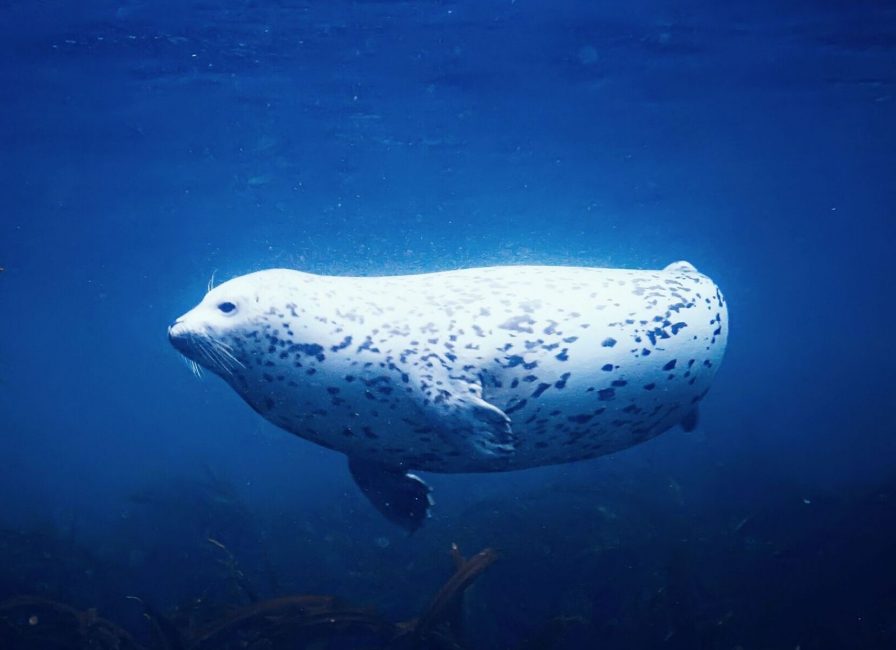
Like most Antarctic seals, Weddell seals are considered true seals. One of the largest Antarctic seals, their body is long and generally rounded, with short fore-flippers in relation to their body. Their head is relatively small with a short, wide snout.
Their fur is generally a mottled dark gray to brown with pale patches on the back, and a silvery-white underbelly.

Unique call
WEDDELL SEAL
Another identifying feature of the Weddell seal is its unmistakable call.
A series of high-pitched pings and boings, it is one of the most distinctive calls in the polar world, and has been described as like a ‘sci-fi spaceship’ or a message from outer space!
WEDDELL SEAL
Listen to the call of the Weddell seal.
Source: Weddell Seal Science
Feeding
WEDDELL SEAL
The Weddell seal diet varies depending on the season and their location, but generally includes small fish (especially notothenioidei), squid, octopus, prawns, and other small marine life.
Weddell seals are prodigious divers, capable of plunging over 2000 feet (over 600 m) and staying underwater for up to 80 minutes at a time. They are also excellent navigators, able to find their way to food sources and back to their point of origin, even in 24-hour darkness.

Winter feeding
WEDDELL SEAL
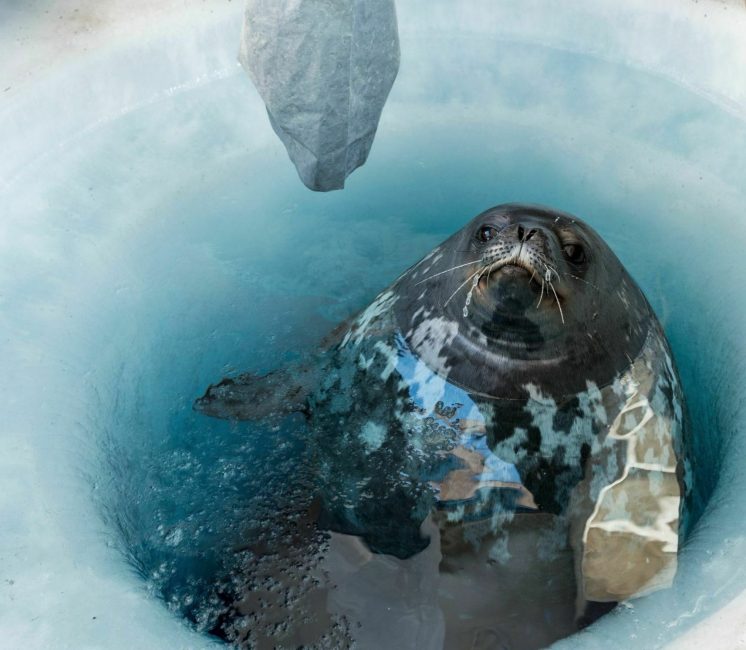
Weddell seals have a unique adaptation that allows them to access open water from their refuge on the ice, even in the depths of winter when natural tidal cracks have frozen over. Using their sharp canines and incisors, they scrape large ‘breathing holes’ in the sea ice, which they use to access their feeding grounds below.
Through the coldest months Weddell seals are often found gathered in small groups around these breathing holes. They tend to them constantly to make sure they don’t freeze over, so they can come up for air, and escape onto the ice to rest or evade predators if needed. Over time this effort wears their teeth down, and they may become unable to maintain their breathing holes. This is thought to be a common cause of Weddell seal mortality.

Predators
WEDDELL SEAL
Weddell seals are preyed upon by orca (killer whales) and leopard seals, both at sea and on the ice.
Their preference for fast ice habitats may be in part due to the protection they offer against predation by other mammals. Weddell seals carve breathing holes to allow them to hunt far from the ice edge and open water. Their predators may hesitate to follow them deep into the fast ice, where they may find themselves stuck, unable to surface and breathe.

Life cycle
WEDDELL SEAL
Weddell seals tend to return to the same colony each year to birth and raise their pups on fast ice (sea ice stuck to the coast). After a gestation period of approximately 11 months, females of around six years and older give birth between September and November, with those at higher latitudes birthing later. While they generally give birth to one pup, they may also have twins, being the only seal species capable of doing so.
In its first week, the pup (or twin pups!) learn to swim and haul out on the ice. They live under the care of their mother for the next six weeks, feeding on milk and growing from around 60 pounds (30 kilograms) to 275 pounds (125 kilograms) before weaning.
There has only been one recorded sighting of Weddell seals mating, which took place underwater. Depending on the timing, pregnancy may be paused by a process called delayed implantation, in which the fertilized egg remains dormant, and does not implant in the wall of the uterus. Hormone regulators stimulate implantation at the right moment, so the pup will be born at the time of year when survival is most likely.
ANTARCTIC SEALS
Related reading

Now that you’ve learned about Weddell seals, read on to learn more about extraordinary Antarctica.
Antarctic Life
FEATURED LEARNING
